Danbooru Tags Explained: How to Prompt Anime AI Generators Like a Pro (2026)
November 21, 2026
🔞 18+ Only: This guide is about prompting anime-style generators for fictional, adult characters. Every worked example below describes an adult woman — stated as an adult in plain terms and tagged as one — because that is both the legal line and, as you’ll see, the technically correct way to tag.
Here is the most common way to waste an evening with an anime generator. You write what works everywhere else — a flowing sentence about a beautiful maid in a sunlit café, the light, the mood, the story — and the model hands you back a generic girl in a generic room who shares perhaps two details with your description. You add more adjectives. It gets worse. The problem is not your imagination, and it isn’t the model’s reading comprehension. It’s the language. The big anime checkpoints were raised on Danbooru, an image board where millions of illustrations are catalogued with terse, standardised tags — and they think in that vocabulary. Feed them prose and half of it evaporates. Feed them tags and suddenly every detail lands.
This guide teaches that vocabulary properly: where the tags come from, the five categories every tag belongs to, how ordering and weighting actually work in each major front-end, and how to convert a sentence prompt into a tag prompt line by line. It is the third leg of our prompting guides — our general prompt guide covers natural-language prompting for realistic output, and our negative prompt master list covers the exclusion side. This one is the positive-tag system for anime models, and it pairs with the AI porn generator you already use once you know which of its models speak tags.
⚡ The Short Version
- Anime models were trained on Danbooru’s captions. Millions of illustrations catalogued with standardised tags — that fixed vocabulary, not English prose, is what Pony, Illustrious, NoobAI and their ancestors actually learned from.
- Every tag belongs to a category: general (the visible facts), character, copyright (the series), artist and meta. Prompting is mostly general tags, assembled in category order.
- Order is a soft priority, not grammar: subject and count first, then appearance, outfit, action, setting, style and quality last. Front-load what matters most; late tags in a long prompt get diluted first.
- Weight syntax is front-end property, not model property: WebUI multiplies attention by 1.1 per bracket pair and supports explicit numbers; ComfyUI accepts the same numbers but applies them differently; NovelAI strengthens with {{ }} at 1.05 a pair. The same prompt does not port verbatim.
- Quality tags are dialects: classic Danbooru sets run masterpiece / best quality / absurdres / highres; NoobAI adds year tags like newest; Pony uses score_9 and the score ladder. Using the wrong family’s dialect spends tokens for nothing.
- There is no negation and no small talk in tags: “no hat” contains “hat”. “Beautiful” is not a tag. For every concept there is one canonical spelling — find it, don’t paraphrase it.
Contents
- Why anime models think in tags: the Danbooru inheritance
- The five tag categories
- Anatomy of a tag: counts, specifics and canonical spellings
- Ordering: the assembly line
- Weights and emphasis: the front-end dialects
- Quality tags: three dialects, three families
- Why natural language underperforms on anime models
- Worked conversion: one sentence, rebuilt as tags
1. Why Anime Models Think in Tags: The Danbooru Inheritance
Danbooru is one of the oldest anime image boards, and its real product is not the pictures — it’s the labelling. Every image on the site is catalogued by its community with a controlled vocabulary: the same concept always gets the same tag, multi-word concepts are joined with underscores (long_hair, looking_at_viewer), and each tag is filed in a category — general, artist, copyright, character or meta. That discipline, applied to millions of images over two decades, produced the largest clean dataset of “picture → exact list of what’s in it” that exists for anime art.
When researchers and later hobbyists trained anime image models, that dataset is what they used — first the pioneering Waifu Diffusion line, then the flood of Stable Diffusion 1.5 anime checkpoints, then the SDXL generation: Pony Diffusion, Illustrious and its NoobAI descendants. Those models never read a novel. Their text encoders learned by pairing images with tag lists, so a tag is not a hint to them — it is a precise retrieval key. Twintails in the training data is a specific, repeatedly demonstrated visual fact. “Hair worn in two playful tails that bounce as she moves” appears in the training data approximately never.
Two practical consequences follow. First, tag vocabulary is finite and knowable: if a concept matters, there is a canonical tag for it, and Danbooru’s own tag wiki documents what each tag means and when to use it. Second, the system has no grammar: tags don’t relate to each other, negate each other or modify each other. There is no “not”, no “very”, no “slightly”. Everything the prose writer does with sentence structure, the tag prompter does with selection, ordering and the weighting syntax of their front-end — which is what the rest of this guide covers.
2. The Five Tag Categories
On Danbooru every tag lives in exactly one of five categories, colour-coded in search results. Models don’t see the colours, but the categories are the best mental model for what a tag does in a prompt — and checkpoint trainers assembled their captions category by category, which is why prompts read best in the same order.
| Category | What it names | Examples | Role in a prompt |
|---|---|---|---|
| General | Everything visibly in the picture: bodies, hair, clothes, actions, objects, settings | 1girl, long_hair, twintails, maid, apron, holding_tray, cafe, sunlight | The working vocabulary — 95% of your prompt |
| Character | A named, specific fictional character | Canonical character names from anime, manga and games | One tag that imports a whole design — face, hair, signature outfit associations |
| Copyright | The series or franchise a character or scene belongs to | Series titles; original when there is no franchise | Anchors a character tag; original declares an invented character |
| Artist | The creator of the source image | Artist names as catalogued on the board | Style steering on Danbooru-trained models — the style is retrieved, not described |
| Meta | Facts about the file, not the scene | highres, absurdres, translated, comic, monochrome | A small useful subset (resolution/quality markers) rides along in prompts; the rest is archive bookkeeping |
The category that does the heavy lifting is general, and it is more expressive than newcomers expect. Danbooru’s taggers developed tags for things prose handles clumsily: exact framings (cowboy_shot — knees up; upper_body; full_body), gaze (looking_at_viewer, looking_to_the_side), hair mechanics (hair_over_one_eye, hair_between_eyes, sidelocks), and micro-expressions (light_blush, parted_lips, raised_eyebrows). If you have ever written “she glances shyly at the camera” and gotten a neutral stare, the tag version — looking_at_viewer, light_blush, shy — exists precisely because a tagger needed to catalogue that exact face.
Character and copyright tags are power tools with a warning label. A well-represented character tag summons a consistent design for free, which is why fan-art prompting leans on them. But the category is only as lawful as its source: franchise characters conceived as minors carry exactly the problem our prompt-rejection guide draws in full — they are refused on serious platforms and should be. For original adult characters, the original copyright tag plus a written-out general-tag description is the professional route anyway: it is portable across models in a way a character name never is.
3. Anatomy of a Tag: Counts, Specifics and Canonical Spellings
Three habits separate tag prompts that land from tag soup. The first is count tags. Anime prompts open by declaring the cast: 1girl, 1boy, 2girls, solo. This is not decoration — the count is one of the strongest composition signals in the vocabulary, because every training caption stated it. Omitting it invites the model to improvise a second character; adding solo reinforces a single subject. Adult scenes state their cast the same way, and an adult cast is stated plainly: the characters in this guide’s examples are adult women, and where a platform or model benefits from the clarity, wording like “adult woman” in the sentence you’re converting keeps the intent unambiguous in a way tags alone support with mature feature tags (see §8).
The second habit is canonical spelling. Tags are lowercase, words joined by underscores in the classic Danbooru form (black_hair, thighhighs is one word, hair_ornament). Most modern front-ends accept spaces instead of underscores and many SDXL-era models were trained on captions rendered with spaces — either convention works on a given setup, but consistency inside one prompt is what matters, and copying a tag’s exact form from the booru or a tag database beats guessing: twintails is a tag, “twin tails” as two concepts is a dilution. Near-misses are the silent failure of tag prompting — long_hair is catalogued; “very long hair” is the tag very_long_hair, and there is even absurdly_long_hair beyond it. The vocabulary has granularity most people never discover because they paraphrase instead of looking it up.
The third habit is one idea per tag. A tag names a single visible fact. Compound prose smuggles in relationships (“the ribbon in her hair matches her dress”) that tags cannot express; the tag version states both facts — red_ribbon, hair_ribbon, red_dress — and lets the model’s learned associations do the matching. When a detail refuses to appear, the cause is usually one of three: the tag doesn’t exist in that form, a stronger tag is contradicting it, or it is sitting too late in a very long prompt. Which brings us to order.
4. Ordering: The Assembly Line
Order in a tag prompt is a soft priority system. Text encoders process the prompt as a sequence, positions are not equal, and in practice the front of the prompt anchors the composition while the tail is spent on finish and polish. Community convention — inherited from how Danbooru captions and checkpoint training strings were assembled — puts the prompt together like an assembly line, and NoobAI’s own model card publishes the recipe in exactly this shape: count, character, series, artist, special tags, general tags.
A working order for an original-character image:
- Quality and rating openers (family dialect — §6)
- Count and subject: 1girl, solo
- Identity: character tag, or your original character’s fixed feature tags
- Appearance: hair (length, style, colour), eyes, build, expression
- Outfit: garment by garment, including the small ones — apron, headdress, thighhighs
- Action and pose: standing, holding_tray, looking_at_viewer
- Setting and light: cafe, indoors, window, sunlight, detailed_background
- Style and finish: artist tags, medium tags, highres/absurdres
Two failure modes live at the extremes. Front-loading trivia — leading with background and lighting — lets the subject be decided by leftovers. The endless tail — forty tags where the last ten are wishes — dilutes everything, because attention is a budget; a tight twenty-tag prompt routinely outperforms a sixty-tag one. Move a must-have detail earlier before you reach for weights; order is the free lever, weights are the paid one.
5. Weights and Emphasis: The Front-End Dialects
Weighting syntax belongs to the front-end — the software between you and the model — not to the model itself. The model only ever receives numbers. That is why the same characters mean different things in different tools, and why copying a prompt between WebUI and a hosted service without translating its brackets is a category error. Here is what the public documentation of each major front-end actually specifies.
| Front-end | Strengthen | Weaken | Step size / notes |
|---|---|---|---|
| AUTOMATIC1111 WebUI (and forks) | (tag) = ×1.1 per pair; ((tag)) = ×1.21; (tag:1.3) explicit number | [tag] = ÷1.1 per pair; (tag:0.8) | Numbers only work inside ( ); [ ] takes no number. WebUI multiplies the token’s embedding directly. |
| ComfyUI (native CLIP encode) | (tag:1.2) explicit; plain (tag) defaults to 1.1 | (tag:0.8); bare [ ] is not the native idiom | Same numbers accepted, different arithmetic: native encoding interpolates toward the unweighted embedding rather than multiplying, so high weights behave less aggressively — and advanced nodes can switch the interpretation entirely. |
| NovelAI | {tag} = ×1.05 per pair; {{tag}} = ×1.1025 | [tag] = ÷1.05 per pair | Curly braces, gentler steps — the syntax WebUI borrowed its implementation from, per WebUI’s own feature notes. Hosted web generators frequently accept no weighting syntax at all. |
Three rules keep weighting sane everywhere. Weight the few, not the many: two or three weighted tags per prompt is a working range; weighting everything is weighting nothing. Small moves: 1.1–1.3 strengthens, 0.8–0.9 softens; pushing a tag past ~1.5 in WebUI-style multiplication starts buying artefacts — the trait arrives but drags distortions with it, the “burn” experienced users recognise. Weight is not a substitute for the right tag: no amount of emphasis on long_hair produces twintails. Fix vocabulary first, order second, weights third.

6. Quality Tags: Three Dialects, Three Families
“Quality tags” are the tags that don’t describe the scene at all — they address the training data’s own judgements. Danbooru captions carried community and curator signals about how good an image was, and models learned to associate those signals with polish. But each model family baked in a different dialect, and dialect tags used on the wrong family are dead tokens.
The classic Danbooru dialect (SD 1.5 anime checkpoints; still the base layer for Illustrious): masterpiece, best quality at the head, with meta-category resolution markers absurdres, highres in the finish. These began life as meta tags about the file and its reception — absurdres literally catalogues an absurd-resolution original — and training turned them into quality levers.
The NoobAI dialect (Illustrious lineage, extended): the same masterpiece ladder, formalised — NoobAI’s model card defines its quality tags by dataset percentile, with masterpiece as the top band above best quality — plus year tags: newest, recent, mid, early, old, which steer toward the era of art the model should imitate, with newest in the family’s recommended prefix and old / early relegated to the negative prompt. Its published prefix runs: masterpiece, best quality, newest, absurdres, highres.
The Pony dialect: Pony Diffusion was trained with an aesthetic-scorer ladder instead of the masterpiece words. Its tags are score_9, score_8_up, score_7_up… down the rungs, and Pony’s own documentation is refreshingly honest that the canonical opener — score_9, score_8_up, score_7_up, score_6_up, score_5_up, score_4_up — works partly as a memorised string: the model learned the whole descending sequence as “the good images” signal. Pony also adds source_anime / source_cartoon / source_furry style-source tags, which have no Danbooru equivalent. Put score_9 on an Illustrious model and nothing happens; put masterpiece on Pony and very little happens. Dialect first, always — and the matching negative-prompt side of each family is catalogued in our negative prompt master list.
7. Why Natural Language Underperforms on Anime Models
None of this means prose is “wrong” — it means prose is a translation the anime model never studied. Four specific losses occur when a sentence meets a tag-trained encoder.
Concepts evaporate. A sentence spends most of its tokens on glue — articles, verbs, prepositions, mood. Those tokens carry no visual training signal, but they occupy sequence space and attention that the content words needed. The model’s effective reading of a forty-word sentence may be six nouns.
Exact concepts blur. The encoder can’t know that your flowing description of hair in two tails should retrieve the twintails cluster — a dense, specific region of its training where thousands of examples agree on the geometry. It assembles an approximation from “hair”, “two” and “tails” instead, and approximation is why sentence-prompted anime drifts generic.
Negation inverts. Tags have no “no”. “A café scene with no people in the background” hands the model people and background as content. Exclusion lives in the negative prompt (a separate channel), never in adjectives. Prose writers reach for negation constantly; tag prompting requires describing the world you want, full stop.
Emphasis has nowhere to live. In prose, importance is conveyed by repetition, position and intensifiers — “very, extremely, incredibly detailed” — none of which the tag-trained encoder prices. In tags, importance is order (§4) and explicit weight (§5): mechanical, auditable, repeatable.
The honest caveat: the newest Illustrious-line models tolerate hybrid prompting — a tag spine with a short natural-language phrase for an unusual action or mood — because their SDXL base was itself trained partly on captions. Hybrids are a seasoning, though. The spine that makes anime models precise is tags, and the conversion below shows how little of a good sentence actually survives translation — because so little of it was load-bearing.
8. Worked Conversion: One Sentence, Rebuilt as Tags
Take a sentence written the realistic-prompt way, about an adult character (in the adult-anime context this site exists for, she is an adult woman, and the tag build keeps her one):
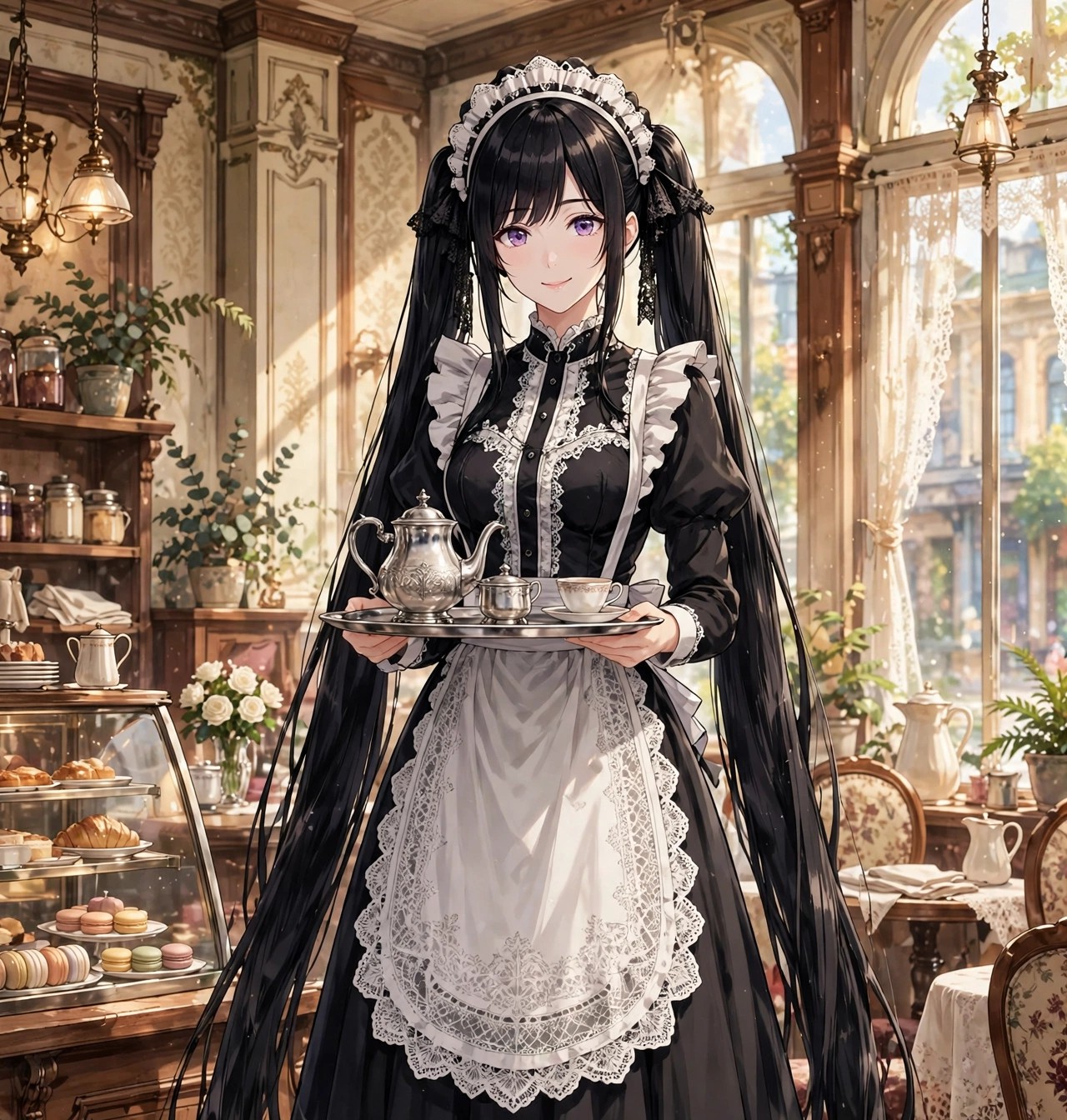
“A beautiful 27-year-old maid with very long black hair in two tails and striking purple eyes smiles gently at you while holding a silver tea tray, standing in an elegant sunlit Victorian café with pastries in a glass case behind her, highly detailed, best quality.”
| Sentence fragment | Tag conversion | What changed and why |
|---|---|---|
| “a … maid” (one woman, adult) | 1girl, solo, maid | The cast is declared with count tags; her adulthood is carried by the mature design tags below — and on the sentence side she was stated as 27, the clarity §3 of our rejection guide asks for |
| “very long black hair in two tails” | very_long_hair, black_hair, twintails | Three canonical tags replace one clause; the vocabulary’s granularity (very_long_hair, not “long”) does the intensifier’s job properly |
| “striking purple eyes” | purple_eyes | “Striking” has no tag and no effect; the eye colour is the entire load-bearing content |
| “smiles gently at you” | smile, looking_at_viewer | Expression and gaze are separate catalogue entries; together they render the exact face the sentence gestured at |
| “holding a silver tea tray” | holding_tray, teapot, teacup | The action tag exists; naming the tray’s cargo sharpens the render more than the metal’s colour did |
| “elegant sunlit Victorian café, pastries in a glass case” | cafe, indoors, sunlight, detailed_background | Setting compresses to its catalogue facts; detailed_background is the honest lever for the pastry-case richness |
| “highly detailed, best quality” | masterpiece, best quality, absurdres | Moved to the head of the prompt in family dialect (§6) — quality tags open, they don’t close |
| “beautiful” | — deleted — | Not a tag, not a signal. Beauty is an outcome of the other tags, not an input |
Assembled, in assembly-line order, for an Illustrious/NoobAI-family model:
masterpiece, best quality, newest, absurdres, 1girl, solo, maid, very_long_hair, black_hair, twintails, purple_eyes, maid_headdress, apron, smile, looking_at_viewer, holding_tray, teapot, teacup, cafe, indoors, sunlight, detailed_background
Same scene on a Pony-family model, the dialect and only the dialect changes: swap the opener for score_9, score_8_up, score_7_up, source_anime and keep every general tag identical. That portability — one vocabulary, swappable quality dialect, front-end-specific brackets only where needed — is the entire payoff. Build your character’s feature block once, keep it in a note, and she is reusable across every anime model you will ever open. On SpicyLab’s AI porn generator, the same vocabulary discipline applies to the anime models in the line-up — and your generations stay private by default, with the price shown before each job runs.
The Bottom Line
Danbooru tags are not a slang layered over prompting — they are the native language of anime models, inherited from the image board whose cataloguing discipline became their training data. Learn the five categories, declare your cast, spell concepts the canonical way, assemble in category order, weight sparingly in your own front-end’s dialect, and open with your model family’s quality tags. Do that, and the vagueness that made you add adjective after adjective to a sentence simply leaves the workflow. Keep the sentence for the realistic models — our prompt guide teaches that craft — and keep the negative list from our master list beside both. Two languages, two model families, no more slot machine.
Frequently Asked Questions
What exactly are Danbooru tags?
They are the standardised labels from Danbooru, a long-running anime image board where the community catalogues every image with a controlled vocabulary: lowercase tags, underscores joining multi-word concepts, each tag filed as general, artist, copyright, character or meta. Because anime image models were trained on millions of images captioned in exactly this format, the tags function as precise instructions to those models — a fixed vocabulary where twintails or looking_at_viewer names a specific, repeatedly demonstrated visual fact.
Do I write tags with underscores or spaces?
Either, on most modern setups. The classic Danbooru form uses underscores (long_hair, looking_at_viewer), and that is how the board writes them; many SDXL-era models were trained on captions rendered with spaces instead, and most front-ends accept both. What matters is consistency inside one prompt and using the canonical concept — very_long_hair rather than a prose paraphrase. Copy a tag’s form from the booru or a tag database instead of guessing it.
Why does my natural-language prompt look generic on anime models?
Because the model was trained on tag lists, not sentences. Most of a sentence’s tokens are grammar glue with no visual training signal, the specific concepts blur (a description of two tails does not retrieve the twintails cluster reliably), and negation inverts — “no people in the background” still feeds the model the concept people. A tight tag prompt spends every token on a demonstrated visual fact, which is why twenty tags outperform forty words.
What order should tags go in?
The convention inherited from Danbooru captions and published on model cards like NoobAI’s: quality tags first, then count and subject (1girl, solo), character or fixed features, appearance, outfit, action, setting, and style or artist tags last. Order is a soft priority — the front anchors the composition and late tags in a long prompt are diluted first — so move a must-have detail earlier before reaching for weights.
How do prompt weights work, and why do they differ between WebUI and ComfyUI?
Weight syntax is a feature of the front-end, not the model. In AUTOMATIC1111’s WebUI, (tag) multiplies the token’s attention by 1.1 per bracket pair and (tag:1.3) sets an explicit multiplier, while [tag] divides. ComfyUI’s native encoder accepts the same (tag:1.2) numbers but applies them by interpolating toward the unweighted embedding, so the effect curve differs; NovelAI uses {{ }} to strengthen at 1.05 per pair. Many hosted web generators accept no weighting syntax at all — brackets there are just characters.
Which quality tags should I use — masterpiece or score_9?
Match the dialect to the model family. Classic Danbooru-trained checkpoints and the Illustrious line respond to masterpiece, best quality, absurdres and highres; NoobAI adds year tags such as newest in its recommended prefix and defines its quality ladder by dataset percentile. Pony Diffusion ignores the masterpiece words in favour of its own scorer tags — score_9 with the descending score_8_up, score_7_up ladder, often written as one memorised string. Dialect tags on the wrong family are dead tokens.